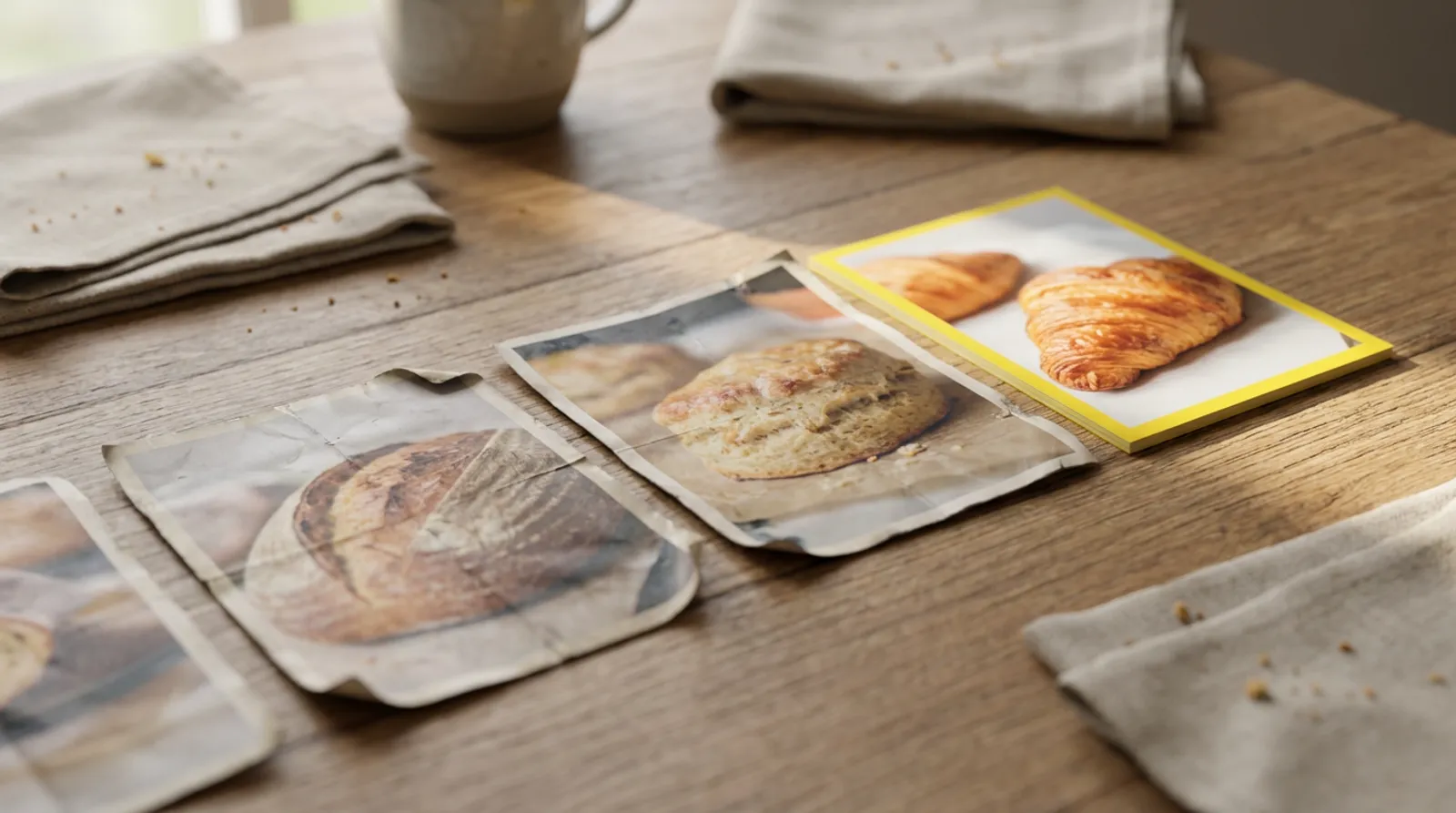
A hook is whatever your ad shows and says in its first moment, and its only job is to make the right person stop. The research from Meta, TikTok and Google points the same way: most of what an ad does happens in the first few seconds, so the best thing you can do is put the thing people want right at the start, in words they can read without sound. Then write more than one and test them.
What is an ad hook?
An ad hook is the opening of an ad: the first picture, the first words on screen and the first sound, usually the first one to three seconds of a video. In a still ad, the hook is the picture and the headline that people take in at a glance before they decide to scroll on.
A good hook does two things. It stops the person you want to reach, and it makes a promise the rest of the ad keeps. If it only does the first, it’s a trick. If it only does the second, nobody sees it.
This post covers what the platforms have measured, what the research on headlines says, and a set of hooks you can borrow.
Why do the first seconds of an ad matter so much?
Because that’s all most people give you. People scroll fast, and an ad that hasn’t shown its point by the second or third second is often gone.
What Meta found
In a 2016 study of feed videos, Facebook IQ found it takes only 0.25 seconds of exposure for people to recall mobile feed content. A quarter of a second is enough for something to stick, which means your first frame is working whether people stop or not.
In research it did with Nielsen, Meta found that up to 47% of the value in a video campaign was delivered in the first three seconds, and up to 74% in the first ten. The same guide says 65% of people who watch the first three seconds of a video will watch for at least ten, and 45% keep watching for thirty.
Research Facebook (now Meta) did with Nielsen, from the time before Reels. Source: Meta for Business, Capture attention with updated features for video ads (2016)
These are older numbers, from a time before Reels, when Meta was still called Facebook. But they match what every platform says today: the start carries most of the weight, and fewer people are left with each second that passes.
What TikTok says about the first seconds
TikTok’s creative best practices, last updated in June 2025, tell advertisers to introduce what they offer in the first 3 seconds for better recall and awareness, and to put the hook within the first 6 seconds to lift engagement and watch time. It suggests doing that with suspense, surprise or other emotions.
In an earlier analysis of its auction ads, TikTok found that over 63% of the videos with the highest click-through rate highlighted their key message or product within the first 3 seconds. In the same 2020 post, it said 40% of the auction ads with the highest view-through rate used on-screen text, and one in three spoke straight to the viewer.
Shares of TikTok’s best-performing auction ads. What they had in common, not proof of cause. Source: TikTok, 9 creative tips to drive auction ad performance (2020)
A fair warning: those figures describe what TikTok’s best ads have in common. They don’t prove the early message caused the clicks. Still, it’s the same pattern Meta saw, from a different platform and a different year.
What Google means by the ABCDs
Google’s guide to effective YouTube ads groups its advice into four letters, the ABCDs:
- Attention: hook the viewer.
- Branding: brand early, often and richly.
- Connection: help people think or feel something.
- Direction: ask them to take action.
You’ll sometimes see them written as “attract, brand, connect, direct”. The idea is the same, and the A comes first for a reason. Google’s advice is to “start big”, with bold images at the very beginning.
In its April 2022 guide, Google says that on average the ABCDs deliver a 30% lift in short-term sales likelihood and a 17% lift in long-term brand contribution, based on a 2021 Google and Kantar study. Kantar says it used its scoring tool to analyse over 11,000 ads in less than a month, looking at 180 creative features. That tool predicts how ads will do rather than measuring sales after the fact, so read the 30% as a strong pointer, not a promise.
What does research say makes people want to know more?
Platform guidance tells you when the hook has to land. Research on headlines tells you a bit about what to put in it. Most of it was done on news headlines rather than ads, so treat it as a guide, not a rule.
The curiosity gap
In a 1994 paper in Psychological Bulletin, the economist and psychologist George Loewenstein described curiosity as a kind of deprivation that comes from noticing a gap in what you know. That is the “information gap” idea behind most curiosity hooks.
A curiosity gap is the space between what a hook tells you and what you want to know next. The trick is to open a small gap and close it fast, ideally in the same ad.
Too much mystery backfires. In a 2025 study in Scientific Reports, Aubin Le Quéré and Matias looked at 8,977 headline experiments and found that when a headline was too vague, making it more concrete raised clicks, but when it was already very concrete, adding more detail lowered them. Their conclusion was that headlines with “just the right amount of information” do best.
For a small business, that usually means: say enough that the right person knows it’s for them, and leave one thing to find out.
Be specific
Specific words are easier to picture, and easier to believe. In a study of customer service conversations published in the Journal of Consumer Research, Packard and Berger found that more concrete language (“that T-shirt in gray” rather than “that top”) made customers happier and more likely to buy again.
It’s a different setting from an ad, but the lesson carries over. “Fresh bread” is a category. “Rye with caraway, out of the oven at 7” is a reason to come in.
Questions in the first line
A question can work as a hook because it asks the reader to answer in their head. In a study reported by the British Psychological Society, Lai and Farbrot found that on a science Twitter feed, question headlines that spoke to the reader (“you”, “your”) were clicked on average 175% more often than statements, and 150% more often when they didn’t. In a second test with product adverts on Finn.no, a Norwegian marketplace, the gap was 257% and 137%. But question headlines for washing machines got fewer clicks than statements, and the researchers couldn’t explain why.
So questions can help, but not always. They work best when the reader already has the problem: “Is your boiler making that knocking sound?” earns its place. “Are you ready for summer?” doesn’t.
Numbers in the hook
You’ll find plenty of claims that numbers in headlines raise clicks by some exact percentage. We couldn’t find a peer-reviewed test behind any of them that we could check, so we’ve left those figures out.
What the research does say is that general headline advice often gets the direction wrong. In a 2025 paper in Marketing Science that looked at thousands of headline experiments, Banerjee and Urminsky found that the cues from earlier research and industry advice do affect clicks, but that the advice “does not always provide useful guidance as to the direction of the effects”.
Our advice: use a number when it’s a real fact the customer cares about, like a price, a time, a count or a distance. “$25 for a first class” is specific. “7 secrets to a better body” is filler.
A word on negative words
In a large study of news headlines, Robertson and colleagues found that each extra negative word in a headline of average length raised the click-through rate by 2.3%, and each positive word lowered it by 1.0%. That’s news, not ads, and it doesn’t mean you should scare people. It does suggest that naming a real problem (“Still dripping?”) can pull harder than a cheerful slogan.
15 hook patterns that work for small businesses
None of these are magic. They are tried shapes you can fill with your own product, place and words. Pick two or three that suit what you sell, write one of each, and test them against each other.
| Hook pattern | What it does | Example |
|---|---|---|
| Show the result first | Opens on the finished thing people want | Salon: the first frame is the finished colour turning to camera |
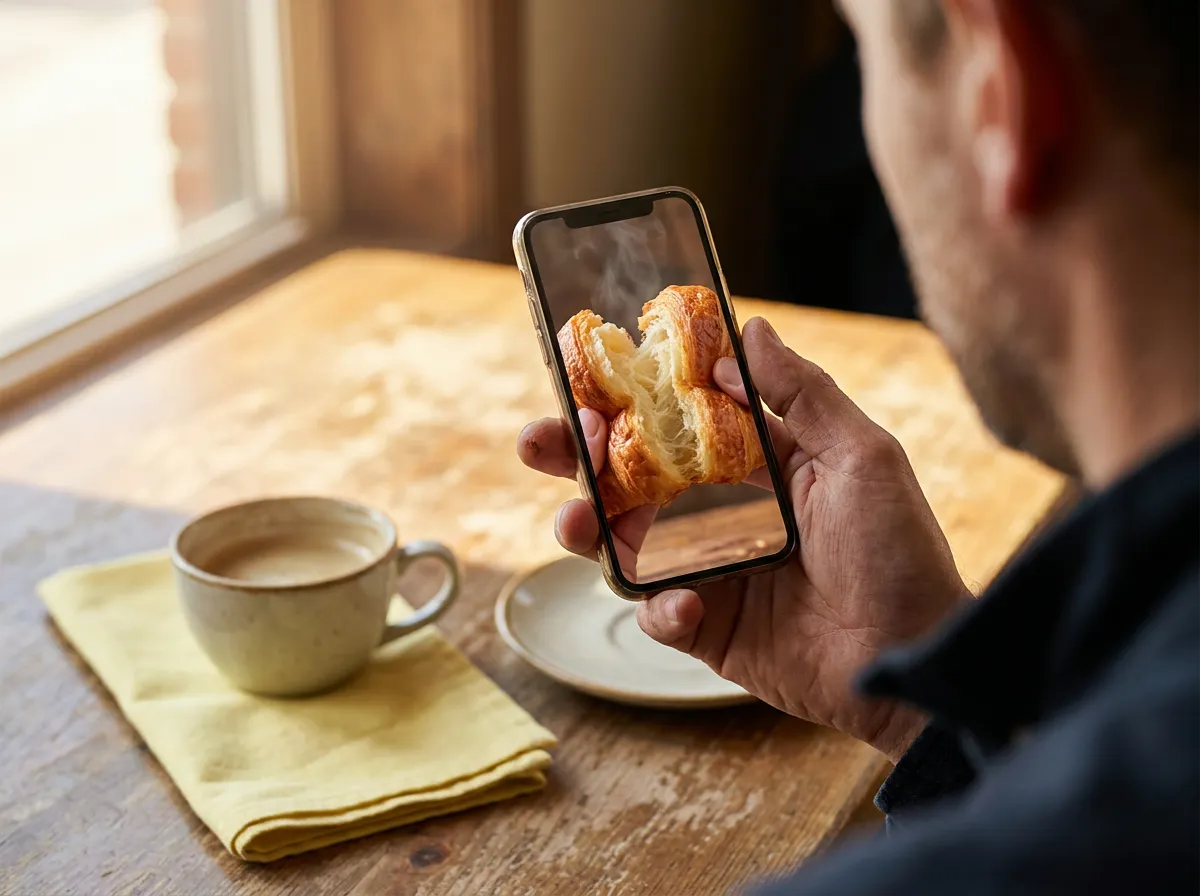
| The thing, close up | Puts the product in frame before anything else | Bakery: a croissant pulled apart, steam and flakes, in the first second |
| Name who it’s for | Makes the right person feel picked out | Gym: “New to lifting and over 40?” |
| The question they already ask | Starts where the customer’s head is | Plumber: “Boiler making that knocking sound?” |
| The problem in one picture | Shows the pain before the fix | Plumber: a drip landing in a bucket, words “Still dripping?” |
| Before and after | Shows the change in two frames | Salon: frizzy, then smooth, split down the middle |
| A real number | Gives a fact people can picture | Bakery: “Out of the oven at 7. Usually gone by 10.” |
| The offer up front | Leads with price or a free first step | Gym: “Your first week costs $0. No contract.” |
| Local and timely | Ties the ad to a place and a date | Bakery: “Pumpkin loaves are back on Elm Street this Saturday.” |
| A small curiosity gap | Opens a question the ad answers fast | Bakery: “The one thing we never put in our sourdough”, then “sugar” |
| The common mistake | Warns against something people do | Plumber: “Don’t pour this down your sink”, then the grease shot |
| Show the making | Lets people see the skill behind it | Online shop: hands stitching a leather wallet, close up |
| The unboxing moment | Starts at the best second of owning it | Online shop: the lid lifting, the product in the light |
| A real customer’s words | Lets someone else make the claim | Salon: a real review line, used with permission |
| Something moves out of place | Breaks the feed’s pattern so the eye stops | Any shop: the product leaps out of the post and over the feed |
A few things all the good ones share: the product or the result is on screen almost at once, the words are short enough to read in a second, and the promise is one the next few seconds keep. If you run a bakery, our page for bakeries shows the kind of openers that suit food. Trades like plumbing have their own on our page for trades.
How do you write a hook for sound-off viewing?
Plan for both. Many people scroll feeds with the sound off, and many people watch Reels with it on, so the opening has to make sense either way.
The case for silent-first is old but clear. In its guide to video ads, Meta said that in one study of Facebook video ads, 41% were basically meaningless without sound, and that its internal tests showed captioned video ads increased video view time by an average of 12%. The same guide said 80% of people react negatively, to both the platform and the advertiser, when feed video ads play loudly when they aren’t expecting it.
Reels are different. In a 2024 post, Meta said over 75% of Reels views on Instagram are sound on, and recommended putting the hook and key messages inside the Reels safe zone, the middle of the screen that the buttons and captions don’t cover.
In practice:
- Put the hook in words on screen in the first second, not only in the voiceover.
- Keep those words short. TikTok suggests showing 5–10 words per second when you use on-screen text, so a hook of five or six words is about right.
- Make the words big, high contrast and inside the safe zone. Our guide to ad sizes shows where the buttons sit on each placement.
- Add sound that helps with the sound on: a real voice, the crackle of a crust, the snip of scissors.
- Watch your own ad muted, on a phone, at arm’s length. If you can’t tell what it’s about in two seconds, neither can anyone else.
Do still ads need a hook too?
Yes. A still ad has no second second, so the picture and headline have to do the whole job at once.
The rules are the same: one clear subject, the product or result front and centre, and a headline of a handful of words that says what people get. Leave space around the words so they don’t fight the picture. A still ad’s hook can also be the contrast: a bright product on a plain background, or a before and after side by side.
Motion helps, too. A small movement in the first frame catches the eye in a way a still can’t, which is why we wrote a whole post on why moving ads stop the scroll.
What makes a bad hook?
Clickbait is a hook that promises something the ad, or the page it leads to, doesn’t deliver. It might win the first second, but it loses the click, the customer and, on Meta, some of your reach.
Meta names two kinds of post it shows to fewer people. Its clickbait links guideline covers posts that “lure people into clicking on an included link by creating misleading expectations”, which can mean withholding information or using sensationalist phrasing. Its engagement bait guideline covers posts that explicitly ask for votes, shares, comments, tags, likes or other reactions for anything other than a specific call to action.
Both sit in Meta’s content distribution guidelines, the list of content Meta thinks may be problematic or low quality, “so we reduce its distribution in Feed for everyone”.
Hooks to avoid:
- “Comment YES if you want one.” That’s asking for comments for their own sake.
- “Tag a friend who needs this.” Same problem, with tags.
- “You won’t believe what happened next.” It withholds the point to force the click.
- “Last chance” when it isn’t. People notice, and they remember.
- A shocking picture that has nothing to do with what you sell.
- A fake play button or a fake message alert. It stops people, then annoys them.
The honest version of every one of these is usually better anyway. “Our pumpkin loaves are back until Sunday” is a real reason to act now, and it needs no bait.
How do you write and test hooks?
You don’t need to guess which hook is best. Keep the rest of the ad the same, change only the opening, and let what people do decide.
- 1Pick one personName who the ad is for and the one thing they want from you.
- 2Write ten openersUse the patterns in the table and keep each to a handful of words.
- 3Show it in the first framePut the product or the result on screen at once, with the words on screen too.
- 4Check it mutedWatch it on a phone with the sound off and make sure it still makes sense.
- 5Run three to fiveKeep the rest of the ad the same and change only the opening.
- 6Keep the winnerCompare how many stopped and how many clicked, then write the next round.
Run a handful at once. TikTok suggests 3–5 different creatives per ad group, which is a sensible number on any platform for a small budget.
Then look at two things. First, how many people stopped: in Meta’s Ads Manager, compare 3-second video plays with impressions. Second, how many of those clicked. A hook that stops lots of people but gets few clicks is promising the wrong thing. A hook that stops fewer people but gets good clicks might be talking to exactly the right ones.
Hooks wear out like any other part of an ad. When the winner starts to slip, write the next round from what you learned. Our post on creative fatigue covers when to swap ads out.
Where AdForThat fits
AdForThat makes finished ads from your website, a sentence about what you sell, your logo or a product photo, so you don’t need to write the hooks yourself. Our break-outs are built around the last pattern in the table: something leaps out of the post and over the feed, in your name, words and colours. In our own experience they have been the best ads we’ve ever run for real businesses, with better engagement, more clicks and more conversions than anything else we’ve tried.
Every ad comes in feed, square, Stories and Reels sizes, and you can launch to Instagram and Facebook from your own Meta ad account. Autopilot keeps the best ads running and puts fresh ones in, which is the testing loop above done for you. You can see how it works before you try it.
Questions people ask
What is a hook in an ad?
A hook is the opening of an ad: the first picture, the first words on screen and the first sound, usually the first one to three seconds of a video. In a still ad it is the picture and headline people take in at a glance. Its job is to make the right person stop and to promise something the rest of the ad delivers.
How long should the hook in a video ad be?
Aim to show what the ad is about within the first three seconds. TikTok’s creative guidance says to introduce what you offer in the first 3 seconds and land the hook within the first 6. Meta’s research with Nielsen found up to 47% of a video campaign’s value came in the first three seconds.
Should my logo be in the first seconds of an ad?
Show the product or the result first, then bring in your name within the first few seconds. Google’s ABCD advice for YouTube is to brand early, often and richly, but people stop for what they want, not for who is selling it. A logo alone is rarely a hook.
Do question hooks work in ads?
They can, when the reader already has the problem. In a study reported by the British Psychological Society, question-style product adverts that spoke to the reader were clicked 257% more often than statements, but questions for washing machines did worse. Ask the question your customer is already asking.
What is engagement bait on Facebook?
Meta defines engagement bait as posts that explicitly ask for votes, shares, comments, tags, likes or other reactions for anything other than a specific call to action. It is listed in Meta’s content distribution guidelines, which cover content Meta shows to fewer people in Feed. Lines like “comment YES” or “tag a friend” fall into it.
How many hooks should I test at once?
Three to five is a good start for a small budget. TikTok suggests 3 to 5 different creatives per ad group. Keep the rest of the ad the same, change only the opening, and compare how many people stopped and how many clicked.
Do I need captions on my video ads?
Yes, or at least the key words on screen. Meta said its internal tests found captioned video ads increased view time by an average of 12%, and that 41% of video ads in one study made little sense without sound. Reels are often watched with sound on, so add useful sound as well.
Sources
- Capturing attention in feed: the science behind effective video creative, Facebook IQ (2016)
- Capture attention with updated features for video ads, Meta for Business (2016)
- Creative best practices for performance ads, TikTok (2025)
- 9 creative tips to drive auction ad performance, TikTok (2020)
- Understanding the ABCDs of effective creative on YouTube, Think with Google (2022)
- Validating Google’s ABCD framework with the power of artificial intelligence, Kantar
- The psychology of curiosity: a review and reinterpretation (Psychological Bulletin), George Loewenstein (1994)
- When curiosity gaps backfire: effects of headline concreteness on information selection decisions (Scientific Reports), Marianne Aubin Le Quéré and J. Nathan Matias (2025)
- How language boosts customer satisfaction (on Packard and Berger, Journal of Consumer Research), Knowledge at Wharton (2021)
- Are you more likely to click on headlines that are phrased as a question? (on Lai and Farbrot, Social Influence), British Psychological Society Research Digest (2013)
- The language that drives engagement: a systematic large-scale analysis of headline experiments (Marketing Science), Akshina Banerjee and Oleg Urminsky (2025)
- Negativity drives online news consumption (Nature Human Behaviour), Claire E. Robertson and others (2023)
- Unlock the power of Reel ads, Meta for Developers (2024)
- Clickbait links, Meta Transparency Center
- Engagement bait, Meta Transparency Center
- Types of content we demote, Meta Transparency Center
Make an ad that does all this
From your website, a product photo or a sentence. Try it free; pick a plan to download and launch.