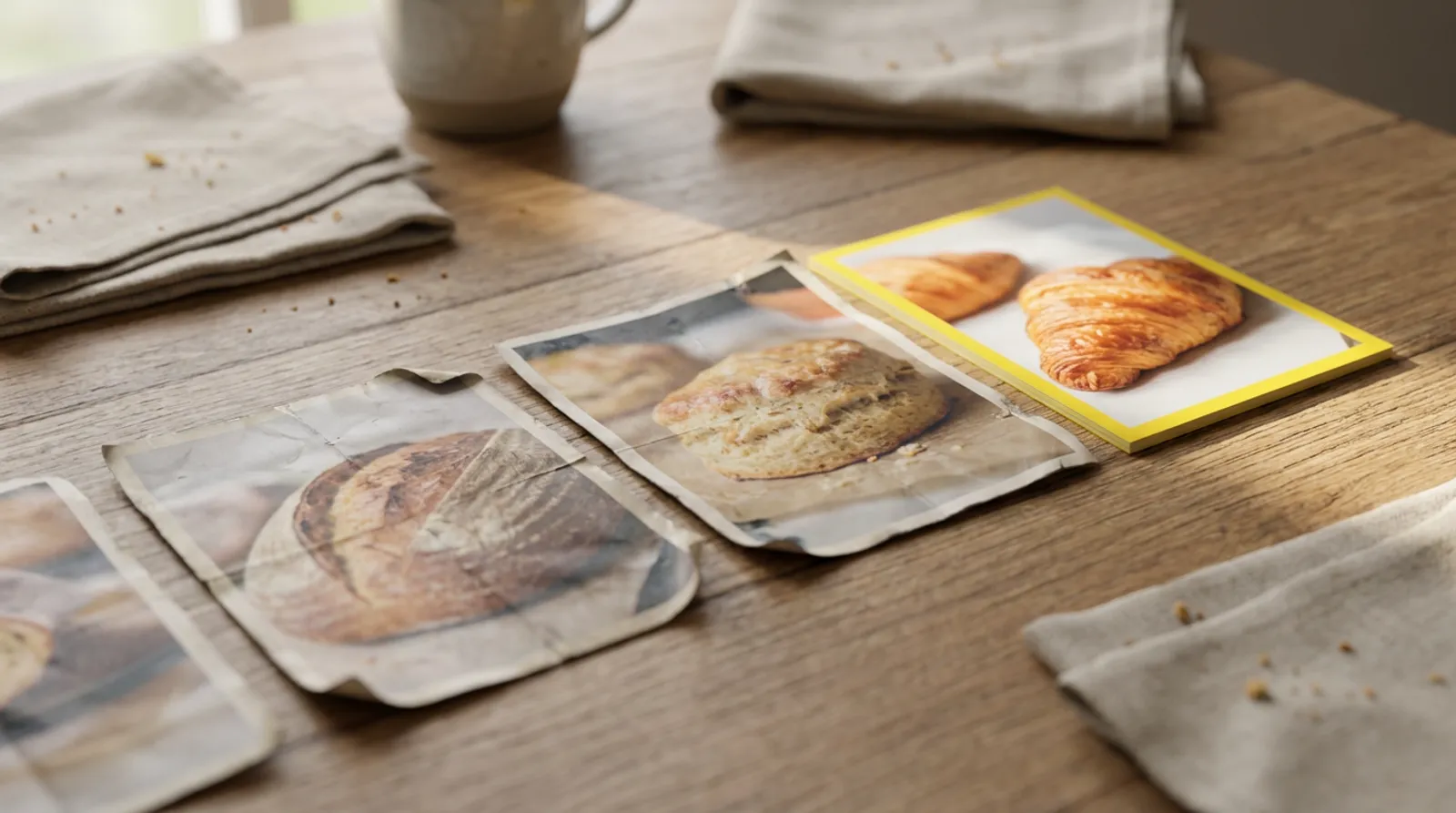
Most people decide whether to stop on a post before they’ve really looked at it, and in that second the eye picks out things that suddenly start moving or seem to come closer. A moving ad that starts clearly gets noticed. A break-out goes further, because something leaves the frame and comes toward the person holding the phone.
How long do people look at a post in their feed?
Not long. In its 2016 research, Facebook IQ found people spent, on average, 1.7 seconds with a piece of content in News Feed on mobile, compared with 2.5 seconds on desktop. The same report says tests by Fors Marsh Group found just 0.25 seconds of exposure was enough for people to recall mobile feed content at a statistically significant rate.
So people do take in what flashes past, but they give it very little time. Newer attention research says much the same. A 2025 article from Amplified, the attention research firm founded by Karen Nelson-Field (author of The Attention Economy and How Media Works), says some social ad formats deliver 0.4 to 1.6 seconds of active attention per view, and most of that attention comes in the first 2.5 seconds.
Active attention is when someone’s eyes are actually on the ad, not just on the screen it’s showing on. Passive attention is when the ad is on screen but their eyes are somewhere else.
How fast do people drop off a video ad?
Very fast. In a 2026 study of 69 video ads from 8 Australian advertisers, Amplified found the feeds it measured besides Snapchat (Meta, TikTok and YouTube) kept only 24 to 32 percent of viewers at three seconds and 8 to 10 percent by the end of the ad. Snapchat kept 74 percent at three seconds. The numbers come from Amplified’s attention models, which simulate viewers using eye-tracking and other data, and the study was described as a first step in work with Snapchat, so read the Snapchat figure with that in mind. The feed figures are the point here: most people are gone before second four.
Modelled from 69 video ads by 8 Australian advertisers. Feeds are Meta, TikTok and YouTube, given as a range; each bar sits at the middle of it. Source: Amplified, 2026 Australian social attention study
Kantar said the same in 2023: attention fades more quickly in short formats such as Stories and TikTok, and in Facebook and Instagram feeds, so brands need to be clear in the first seconds. This is why the first frame matters so much, and why we wrote a whole post on hooks for the first seconds.
Why does the eye notice movement?
Because it’s built to. A sudden movement often means something that needs a reaction, and vision scientists have tested exactly which kinds of motion pull attention. The answers are more specific than “movement”.
The start of motion
Motion onset is the moment something that was still starts to move. In a 2003 paper in Psychological Science, Abrams and Christ found that motion by itself did not automatically draw attention, but motion onset did. Letters that had just started moving were found faster than the rest, even though their movement told people nothing useful.
This matters for ads. A thing that has been moving all along fades into the background. A thing that starts moving is what the eye jumps to.
Things coming closer
A looming object is one that grows on screen, as if it’s coming toward you. In the same year, Franconeri and Simons showed in Perception & Psychophysics that moving and looming objects capture attention, but receding ones, which shrink as if moving away, do not. They suggested that things which might signal an urgent event get priority, which makes sense: an object heading for your face needs a reaction, an object leaving doesn’t.
Surprise
The eye also goes where the unexpected happens. In a 2009 study in Vision Research, Itti and Baldi found that 72 percent of people’s gaze shifts went to places more surprising than average, rising to 84 percent in places every viewer looked at. Surprise, in their sense, is how much something changes what you expected to see.
What does advertising research add?
It mostly agrees with the lab, and adds two practical points: show the picture, and show who it’s from early.
Across 1,363 print ads tested with eye-tracking on more than 3,600 people, Pieters and Wedel found in 2004 that the picture was best at capturing attention, whatever its size, and the brand was best at passing attention on to the rest of the ad. In a feed, the moving picture does the stopping and your name tells people whose it is.
The early seconds also carry most of the value. When Nielsen analysed 173 of its brand studies of Facebook video ads, Meta reported in 2015 that people who watched under three seconds created up to 47 percent of a campaign’s total value, and people who watched under 10 seconds up to 74 percent, depending on the metric. A view that short only helps if the brand and the product are already on screen.
The platforms’ own creative advice follows from this:
- Facebook IQ says video ads in the feed need to bring the brand to the front to capture attention quickly, and be understandable without sound by using captions or other visual techniques.
- TikTok’s creative best practices, last updated June 2025, say to introduce what you’re offering in the first 3 seconds and land your hook in the first 6, using suspense, surprise or other emotions.
- The same TikTok page suggests 5 to 10 words per second when you put text on screen, which is a useful ceiling.
Share of the top ads by click-through rate (first row), of the best-performing ads (second) and of the top ads by view-through rate (third and fourth). Source: TikTok, 9 creative tips for auction ads, 2020
In a 2020 post on its best-performing auction ads, TikTok said over 63 percent of the videos with the highest click-through rate put their key message or product in the first 3 seconds, and that videos shot vertically had an average 25 percent higher 6-second watch-through rate. If you’re not sure which shapes to make, our guide to ad sizes for 2026 covers each placement.
Do moving ads beat still ones?
Often, but not by magic. The best evidence says motion helps when it’s built for the feed, and hurts when it’s just decoration.
On the helpful side, in an eye-tracking study of 1,800 Pinterest users run with Pinterest, Lumen found max-width video drove twice the brand recall of static formats. The same study found ads on Pinterest were viewed for an average of 1 to 2 seconds, so the video had to work in that window too.
On the other side, in a 2012 eye-tracking study of web banners, Lee and Ahn found animated banner ads attracted less attention than static ones, and the animation weakened the link between looking at an ad and remembering it.
The two findings fit together once you remember Abrams and Christ: what catches the eye is a clear start, not constant movement. A full-screen video that opens on the product moving toward you is a different thing from a banner that blinks in the corner of a web page.
| What the research found | Who found it | What it means for your ad |
|---|---|---|
| The start of motion draws the eye, ongoing motion doesn’t | Abrams and Christ, 2003 | Begin with a clear move, not a still title |
| Approaching objects capture attention, receding ones don’t | Franconeri and Simons, 2003 | Bring the product toward the viewer |
| Surprising spots attract most gaze shifts | Itti and Baldi, 2009 | Do one thing people don’t expect |
| The picture captures attention, the brand passes it on | Pieters and Wedel, 2004 | Lead with the product, then your name |
| Views under 3 seconds made up to 47% of campaign value | Meta and Nielsen, 2015 | Say the important part first |
| Animated banners got less attention than static | Lee and Ahn, 2012 | Busy motion can do worse than none |
What is a break-out ad?
A break-out ad is a moving ad where something seems to leap out of the post and over the feed around it. The post shows a frame, a box, a phone screen or a card, and partway through, the product or a character pushes past its edge toward the viewer.
It borrows from anamorphic and forced-perspective 3D billboards, the big street screens where a shoe or a wave seems to burst out into the road. As the studio Groove Jones put it in 2023, these billboards create an optical illusion that makes flat images look as if they extend out into the real world. Anamorphic art is a picture drawn distorted on purpose, so that it only looks right, and three-dimensional, from one viewpoint. A street screen has to guess where people will stand. A phone is easier, because most people look at it straight on.
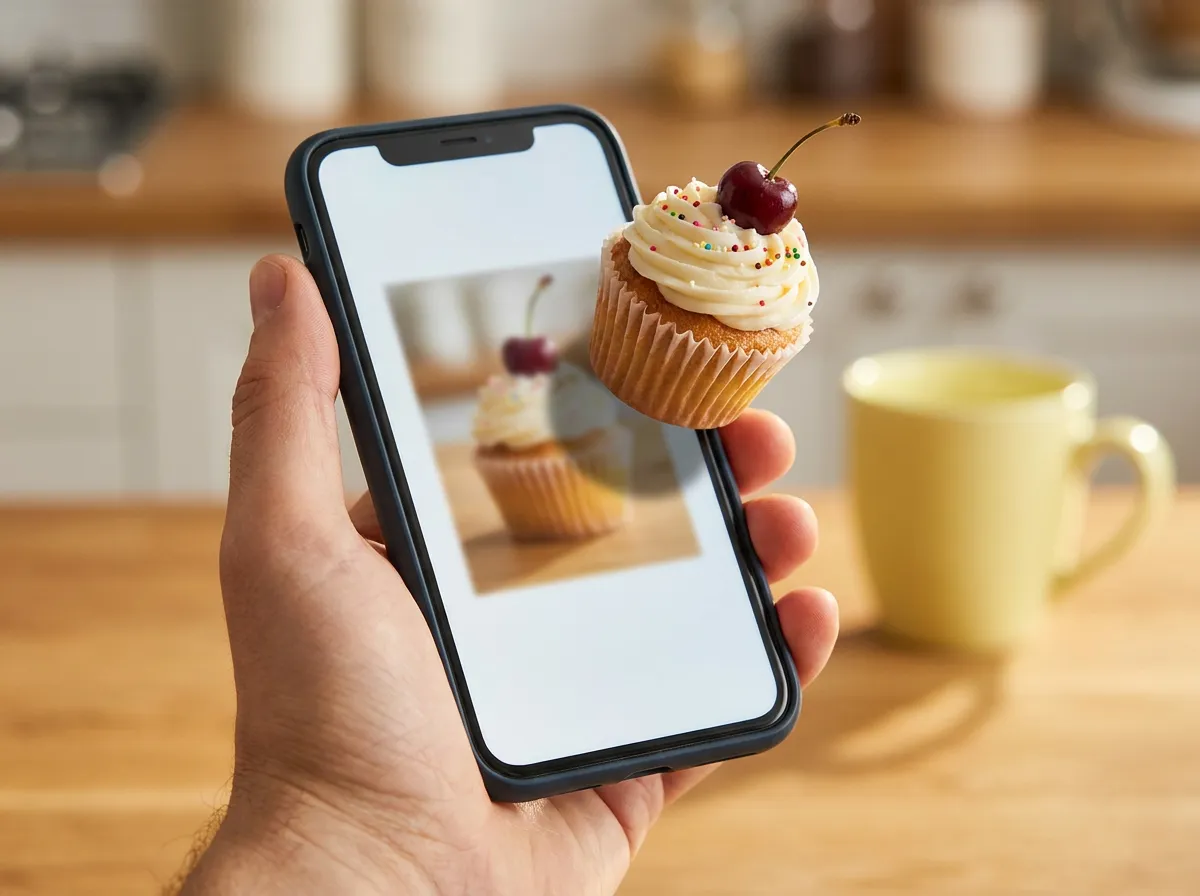
For a bakery that might be a cake rising out of its box and over the edge of the post. For a gym, a kettlebell swinging out of the frame toward the camera.
Why does breaking the frame work so well?
Nobody has run a lab study on break-out ads in Instagram feeds that we know of, so here’s the honest version: the effect lines up with several things the research above has found, all at once.
The edge of a post is a boundary the eye has learned
Figure–ground organisation is how the eye sorts a scene into things and the background behind them. It’s one of the oldest topics in vision science, and a 2012 review by Wagemans and colleagues covers a century of research on it, including border ownership: the brain working out which side of an edge a shape belongs to.
A feed is a stack of boxes, and people learn quickly that everything inside a box is a picture, flat and safe to scroll past. When an object crosses that edge, it stops behaving like part of a picture. Our reading is that this breaks the sorting the eye has been doing all along, and that’s the moment of surprise Itti and Baldi measured.
It’s motion onset and looming in one move
A break-out usually starts still, then moves (onset), and the object grows as it comes out toward the viewer (looming). Those are the two kinds of motion the lab work found the eye prioritises. The way an object moves matters too: something that drifts away into the picture is the receding motion Franconeri and Simons found didn’t capture attention.
It interrupts the pattern
A pattern interrupt is anything that breaks what the viewer expects to see next. After a few dozen posts that all stay in their boxes, one that doesn’t is the most unexpected thing on the screen.
What we’ve seen ourselves
In our own experience, break-outs have been the best ads we’ve ever run, for real businesses, better than anything else we’ve tried, with better engagement, more clicks and more conversions. We can’t promise a number for your business, and the research above doesn’t prove it for any one ad. It explains why it keeps happening.
When doesn’t motion help?
Motion is a tool, and the same research shows how it goes wrong.
- Everything moving at once. Abrams and Christ found ongoing motion didn’t capture attention, and Lee and Ahn found animated banners got less attention than still ones. If the background, the words and the product all move, nothing stands out. Move one thing.
- A slow intro. Kantar found attention in one example ad started dropping right from the first few seconds. A logo fade, a wide shot of your shop or a slow zoom spends the only seconds most people will give you. Start on the move.
- Motion away from the viewer. Receding objects didn’t capture attention in Franconeri and Simons’s tests. Have things arrive, not leave.
- The brand comes too late. If views under three seconds carry up to 47 percent of the value, an ad that shows your name at second eight has wasted most of it.
- It needs sound to make sense. Facebook IQ’s advice is that feed video should be understandable regardless of sound. Put the main words on screen.
- Too many words. TikTok’s ceiling of 5 to 10 words per second is a good test. If people can’t read it in time, cut it.
- The same ad for months. Even a strong opening wears out as people see it again. Our post on creative fatigue covers when to swap it.
A checklist for moving ads
- 1Move in the first frameOpen with something starting to move, not a still title or a slow fade.
- 2Bring it toward the viewerLet the product grow and come closer, never drift away.
- 3Move one thingKeep the background and words calm so the moving thing stands out.
- 4Show your name earlyHave the product and your name on screen within the first two seconds.
- 5Make it work silentPut the main words on screen, few enough to read at a glance.
- 6Use the edgeLet something cross the frame of the post, the move people least expect.
Before you launch, watch the ad on your phone with the sound off and stop it at the two-second mark. If you can’t tell what it’s selling and who it’s from by then, fix the opening first.
Where AdForThat fits
AdForThat makes finished ads for small businesses from a website, a sentence about what you sell, a logo or a product photo. Its main format is the break-out: ready-made 3D clips where something leaps out of the post and over the feed, in your business’s name, words and colours, alongside moving ads, drawn ads and screen ads for apps. Each one comes in the sizes feeds, Stories and Reels use.
You can launch them to Instagram and Facebook from your own Meta ad account, with TikTok, YouTube and LinkedIn coming soon. See how it works if you’d like to try a break-out of your own.
Questions people ask
Why do moving ads get more attention than still ones?
The eye is quick to notice anything that starts to move or comes toward it. A 2003 study by Abrams and Christ found the onset of motion draws attention even when it carries no useful information. In a feed where people spend under two seconds on a post, that reflex is often what decides whether they stop.
How long do people look at an ad in their feed?
Not long. Facebook IQ found in 2016 that people spent 1.7 seconds on average with a piece of mobile feed content, against 2.5 seconds on desktop. Amplified said in 2025 that most of the active attention social ads get comes within the first 2.5 seconds.
What is a break-out or 3D pop-out ad?
It is a moving ad where something seems to leap out of the post and over the feed around it, such as a product rising out of a frame toward the viewer. It borrows the idea from anamorphic 3D billboards, which use forced perspective to make flat screens look as if things are coming out of them.
Are video ads always better than image ads?
No. Motion helps when it starts clearly and points at one thing, and it can hurt when it is busy. In a 2012 eye-tracking study, Lee and Ahn found animated banner ads drew less attention than static ones. Test both, and make sure any video opens on the product.
What should happen in the first three seconds of a video ad?
Show the product, start the main movement and get your name on screen. When Nielsen analysed 173 brand studies, Meta reported that people who watched under three seconds created up to 47 percent of a video campaign’s value. TikTok advises introducing what you offer in the first 3 seconds.
Do I need sound for a moving ad to work?
No, and it should not rely on it. Facebook IQ advises that feed video ads be understandable regardless of sound by using captions or other visual techniques. Put the main words on screen and keep them short.
Sources
- Capturing attention in feed: the science behind effective video creative, Facebook IQ (Meta) (2016)
- What attention science says about your paid social strategy, Amplified (2025)
- Australian brands are losing 63 cents in every social media dollar to low-attention formats, Amplified (2026)
- Beyond viewability: the role of attention in creative effectiveness, Kantar (2023)
- Motion onset captures attention (Psychological Science 14(5), 427–432), Richard A. Abrams and Shawn E. Christ (2003)
- Moving and looming stimuli capture attention (Perception & Psychophysics 65(7), 999–1010), Steven L. Franconeri and Daniel J. Simons (2003)
- Bayesian surprise attracts human attention (Vision Research 49(10), 1295–1306), Laurent Itti and Pierre Baldi (2009)
- Attention capture and transfer in advertising: brand, pictorial, and text-size effects (Journal of Marketing 68(2), 36–50), Rik Pieters and Michel Wedel (2004)
- The value of video for brands, Meta for Business (Nielsen analysis) (2015)
- Creative best practices for performance ads, TikTok Ads (2025)
- 9 creative tips to drive auction ad performance, TikTok for Business (2020)
- Pinterest identifies +62% higher attention uplift with Lumen’s eye-tracking technology, Lumen Research (2023)
- Attention to banner ads and their effectiveness: an eye-tracking approach (International Journal of Electronic Commerce 17(1), 119–138), JooWon Lee and Jae-Hyeon Ahn (2012)
- 3D billboards 101: anamorphic and forced perspective OOH campaigns, Groove Jones (2023)
- A century of Gestalt psychology in visual perception: I. Perceptual grouping and figure–ground organization (Psychological Bulletin 138(6), 1172–1217), Johan Wagemans and colleagues (2012)
Make an ad that does all this
From your website, a product photo or a sentence. Try it free; pick a plan to download and launch.