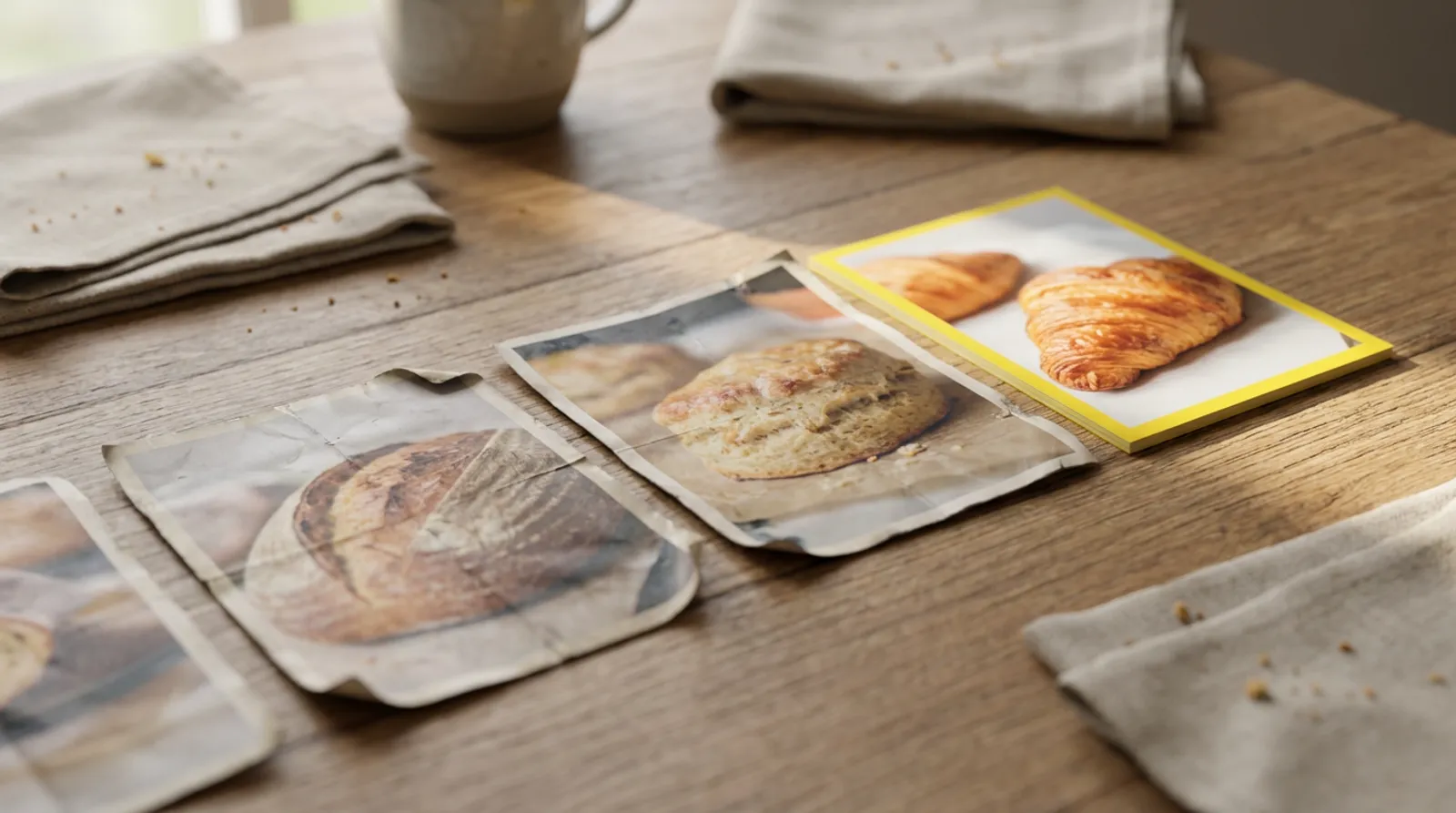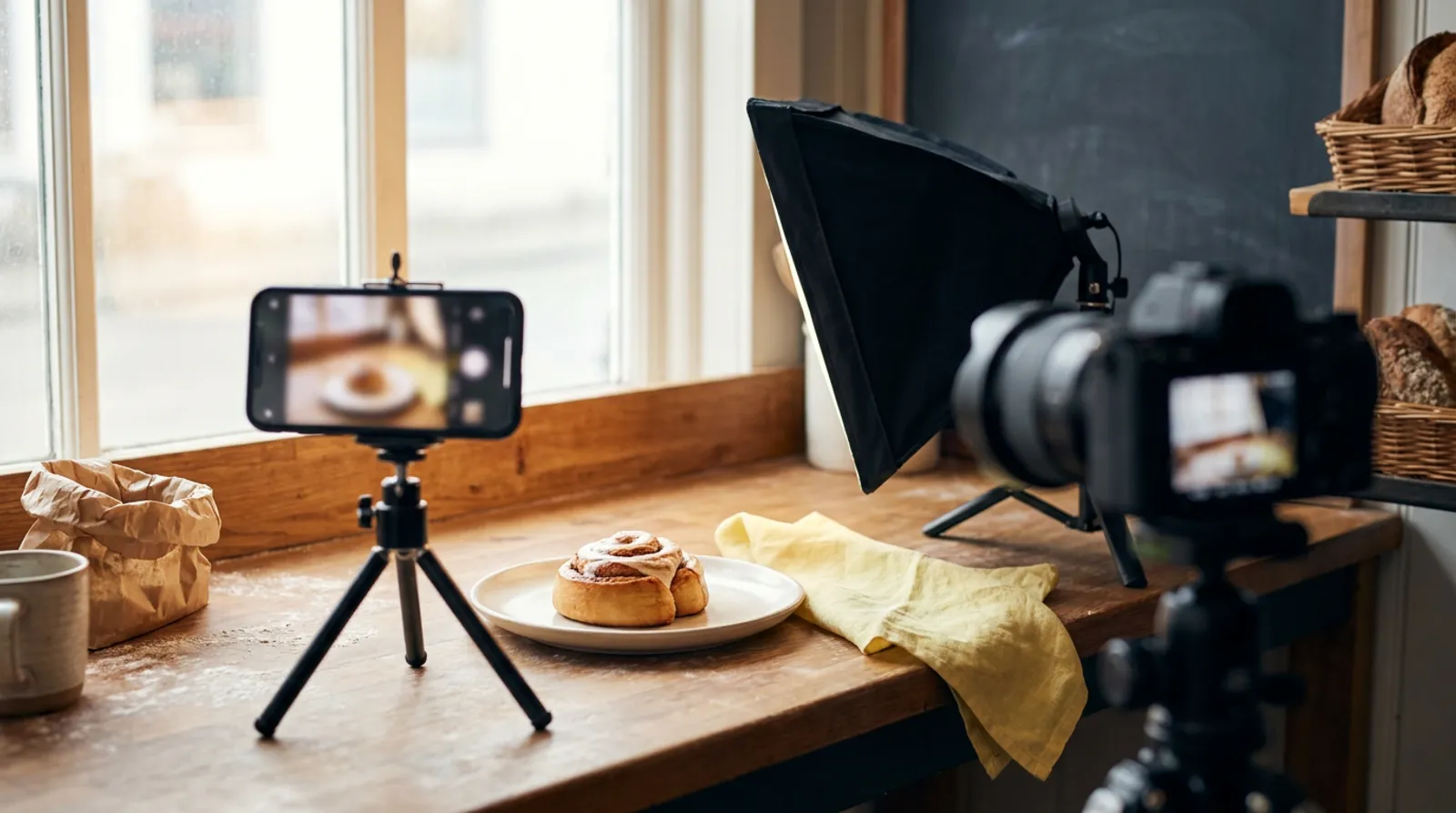
For most small businesses, the answer isn’t one or the other. Phone-shot ads that look like normal posts tend to win on attention and feel, because they fit the feed. Polished ads tend to win on clarity and on getting your name remembered. The best results usually come from testing both and keeping what sells.
What is a UGC-style ad, and what is polished creative?
User-generated content (UGC) is anything made by customers rather than the business: a review, a photo of a new haircut, a video of someone opening a parcel.
A UGC-style ad is a paid ad made to look like that kind of post. It’s usually shot on a phone, vertical, often with one person talking to camera, natural light and plain edits. Most are made by paid creators, not real customers.
Polished creative is the other end. It’s planned, lit and edited, often by a photographer, studio or agency, with clean product shots, set type and a consistent look.
Most ads sit somewhere in between. A baker who films the morning’s croissants on her phone, then adds her logo and a clear offer, has made something lo-fi in look but carefully put together.
One difference matters for everything below. Much of the research on trust is about real customers talking about a business. A paid creator borrows that look, but it’s still an ad, and it has to be labelled as one.
What do the platforms say about UGC-style ads?
Each platform has advice, and each has a stake in it: they all want ads that keep people scrolling. Treat their numbers as useful, not neutral.
TikTok: “Don’t make ads, make TikToks”
TikTok’s slogan is the clearest version of the case for lo-fi. In a 2021 post on its business blog, TikTok said the line was an invitation to be more creative and more authentic, not a ban on ads, and that all ads on TikTok still have to be labelled.
Its Marketing Science team then put numbers to it. In a January 2022 analysis of about 2,800 ads from around 220 brand lift studies in five European markets, TikTok found ads made for TikTok with a creator partner had 83% higher engagement rates, against 12% higher for ads made for TikTok without one.
The gap was biggest for holding attention. Creator ads had 91% higher 6-second view rates, while TikTok-made ads without a creator had 8% higher. TikTok’s write-up doesn’t spell out the comparison, but it implies both are measured against ads that weren’t made for TikTok.
About 2,800 ads from around 220 brand lift studies in the UK, France, Germany, Spain and Italy, October 2020 to May 2021. The baseline, as TikTok’s write-up implies, is ads not made for TikTok. Source: TikTok Marketing Science, 2022
TikTok added a caveat worth keeping. It said making TikTok-style ads or working with creators isn’t necessarily enough to lift every measure, and that brand awareness and click-through rate also depend on things like the call to action and the message.
Meta: built for the phone, and a push towards creators
Meta’s creative advice for Reels is mostly about format, not polish. Its November 2024 guide to Reels ads says to build vertical 9:16 video with audio and keep key messages inside the safe zone, and notes that over 75% of Reels views on Instagram are sound on. Our guide to ad sizes for 2026 covers the shapes.
Meta’s biggest recent bet is on creators. Partnership ads run a creator’s post as an ad, under the creator’s name, with a paid partnership label. In a white paper published in October 2026 and reported by PPC Land, Meta said campaigns where at least 30% of the ads were partnership ads had a 45% lower median cost per incremental purchase, across 20 conversion lift studies in Europe, the Middle East and Africa.
That’s Meta’s own data, measured with its own tools, and PPC Land points out the stated confidence was 92%, below the usual 95% bar. It’s a reason to try creator ads, not proof they’ll work for you.
We also looked for Meta’s own research on phone-shot versus studio-shot ads. Claims that mobile-shot Stories ads beat studio-shot ones are repeated widely, but we couldn’t find the original study online, so we’ve left those numbers out.
YouTube and Google: the ABCDs
Google’s framework for YouTube ads is called the ABCDs. Its guide to effective YouTube creative sums them up as Attention (hook the viewer), Branding (brand early, often and richly), Connection (help people think or feel something) and Direction (ask them to take action).
Google says that on average the ABCDs deliver a 30% lift in short-term sales likelihood and a 17% lift in long-term brand contribution, citing a 2021 study with Kantar. Kantar’s write-up shows it scored about 11,000 ads with a prediction model, so those are predicted lifts, not measured sales.
Notice what isn’t on the list. None of the four says “be polished” or “be lo-fi”. A shaky phone video that never shows your name fails the B. A studio ad that opens on a slow logo fails the A. Our guide to hooks for the first seconds goes into the A.
Why do people trust ads that look like real posts?
Perceived authenticity is how real and unscripted something feels to the person watching it. Trust tends to follow it.
In its 2021 Trust in Advertising study, Nielsen found 88% of people in a global survey of more than 40,000 trusted recommendations from people they know, the most trusted source it measured. In Nielsen’s US results the figure was 89%, and real-life situations were among the five kinds of message people liked most.
Academic studies point the same way, with an important catch.
- Real customers move sales. A study in Information Systems Research (2013) linked a clothing brand’s Facebook community to shoppers’ purchase records and found that, overall, content from users had a stronger effect on spending than content from the brand.
- Posts that don’t look like ads don’t raise defences. In an experiment in the International Journal of Advertising (2020), posts from users didn’t trigger the “someone is selling to me” reaction that disclosed ads did, and led to higher purchase intention than both disclosed ads and brand posts.
- Labels change that. A 2017 study in the Journal of Interactive Marketing found a “Sponsored” label made people recognise a celebrity’s post as advertising, which made them more distrustful of it and less likely to pass it on.
Put together, part of UGC’s edge comes from people not seeing it as an ad. A paid creator ad has to be labelled, so some of that edge goes. What stays is the look and feel: a person, a real place, plain speech. In a feed full of friends’ posts, that still counts.
The look matters outside paid ads too. Social media analytics company Dash Social studied nearly 2,000 Reels from 150 brands posted in 2022 and found phone-shot videos averaged 40% more views and 30% higher reach than professionally produced ones.
Organic posts, not paid ads: 150 brands, nearly 2,000 Reels posted January to September 2022. Dash Social doesn’t define effectiveness rate on the page. Source: Dash Social, lo-fi vs hi-fi video study, 2022
These were brands’ own posts, not paid ads, and Dash Social sells social media tools. But lo-fi came out ahead in every industry it looked at, luxury included.
When does polished creative work better?
Polish earns its cost in a few clear cases.
When people need to see the product clearly
If the picture is how people judge what they’re buying, picture quality shows up in sales. A 2022 study in Management Science found Airbnb homes with verified photos from Airbnb’s photographers had 8.98% higher occupancy than comparable homes with photos taken by the host.
The same goes for a wedding cake, a new kitchen or a colour job at a salon. A clean, well-lit picture of the finished thing does the selling, and someone talking about it doesn’t replace seeing it. If you run a salon or work in the trades, your best before-and-after shots deserve good light.
When you need people to remember your name
Creator content often gets attention without building the brand. In a June 2026 study of more than 15,000 branded creator posts on TikTok, YouTube Shorts and Instagram, Kantar found only 6% delivered both strong engagement and strong brand-building potential. In its Cannes 2026 write-up, Kantar added that platform engagement lined up with brand-building results only about a third of the time.
So likes and views aren’t proof an ad works. If the creator is the star and your name only turns up in the caption, people may enjoy the video and forget who it was for. Polished ads usually put your name, logo and colours in every frame, which is Google’s B in practice.
When the purchase is bigger or the claims are tricky
For a dentist, a clinic or anything with health or money claims, a creator speaking off the cuff can say things you can’t back up, and in the US the business answers for that (more below). A scripted, checked ad is safer here, even if it looks less like a post.
Premium brands are a mixed case. The luxury brands in Dash Social’s study still did better with lo-fi Reels, so “premium means polished” isn’t a rule. But people paying more usually want to see detail and finish, which takes good light and a steady shot, whatever the camera.
What are the rules for paid creator ads?
If you pay a creator, or give them free products, the ad has to say so. In the US the rules are the FTC’s Endorsement Guides, which were updated in June 2023 for the first time since 2009. The main changes:
- fake reviews count as endorsements, and so do virtual influencers and tags on social media;
- disclosures must be “clear and conspicuous”, a term the Guides now define, and a platform’s built-in tool may not be enough on its own;
- advertisers, creators and the agencies between them can all be liable;
- advertising aimed at children is a special concern.
The FTC’s FAQ on the Endorsement Guides adds the practical detail:
- “#ad”, “Ad:” or “Advertisement” at the start of a post are likely to work;
- in a video, put the disclosure in the video itself, not only in the description, and ideally both on screen and spoken;
- disclose in the same language as the endorsement;
- free products count as a connection that may need disclosing;
- the business is ultimately responsible for what others do on its behalf.
The FTC has since gone further. Its final rule on fake reviews, announced in August 2024, bans reviews and testimonials that pretend to be from someone who doesn’t exist, including ones made with AI, or from people with no real experience of the business. The FTC can seek civil penalties from people who break it knowingly.
That rules out a popular shortcut: an actor or a generated face posing as a happy customer. A UGC-style ad can show a real person who really uses your product, or you talking about your own business. It can’t invent a customer.
On the platforms themselves:
- Meta asks creators to mark brand deals with its Paid partnership label, and when a brand puts money behind that post as a partnership ad, it also carries an “Ad” label.
- TikTok says all ads on TikTok must follow its terms and be labelled.
Rules outside the US differ in detail but follow the same idea: if it’s paid, say so. Check with your local advertising regulator before you hire creators.
UGC-style vs polished: how do they compare?
| UGC-style | Polished | |
|---|---|---|
| Cost to make | Low: a phone, a person, a few hours | Higher: a photographer, studio or agency |
| Speed | Same day to a few days | Usually days to weeks |
| Trust and feel | Feels like a post from a person, a little less so once labelled | Reads as an ad straight away |
| Product clarity | Can be dim, shaky or cluttered | Clean light, sharp detail, true colour |
| Brand recall | At risk if the creator is the star and your name is only in the caption | Name, logo and colours in every frame |
| Fatigue | Wears out like any ad, but cheap to replace | Wears out too, and costs more to replace |
| Rules | Paid creator posts must be labelled, and you answer for what creators say | Your own ad and your own claims |
| Best for | New offers, how-it-works videos, real reactions, Reels and TikTok | Product detail, launches, premium work, careful claims |
Creative fatigue is when people have seen an ad so often that it stops working. It catches both styles. Lo-fi just makes it cheaper to swap in a fresh one. Our guide to creative fatigue and how often to refresh covers the signs.
Should you test both?
Yes, almost always. The evidence for UGC-style ads comes mostly from the platforms, results vary by trade, and TikTok itself says creator ads don’t guarantee a lift on every measure. Your own customers are the only sample that counts.
A fair test changes the style and keeps everything else the same.
- 1Pick one offerUse the same offer, price and link in both ads, so the only difference is the look.
- 2Make one of eachOne phone-shot ad and one polished ad, both vertical, both showing your name early.
- 3Split it evenlySame audience, same budget, and your ad account’s A/B test option if it has one.
- 4Give it a weekDon’t call it after a day; let both ads reach enough people to tell them apart.
- 5Judge on salesCompare cost per booking, order or lead, not likes or views.
- 6Keep the winnerLeave the winner running and test a fresh challenger against it.
Judge on cost per booking, order or lead, not likes. Kantar’s finding that engagement and brand results lined up only about a third of the time is a good reason to look past the heart count. For what a good result looks like in your trade, see our Facebook and Instagram ad benchmarks, and for budgets, how much a small business should spend on ads.
Is there a middle path?
Often the best ad is a bit of both: real pictures of your actual business, made clear and tidy. Your own photos of your shop, your team’s hands at work, your real product on your real counter, with clean type, your colours and one clear offer.
That keeps what people trust about UGC (it’s real, and it’s yours) and what polish does well (it’s clear, and it’s obviously you). It needs no creator, no invented customer and no label beyond the platform’s own “Sponsored” or “Ad” tag.
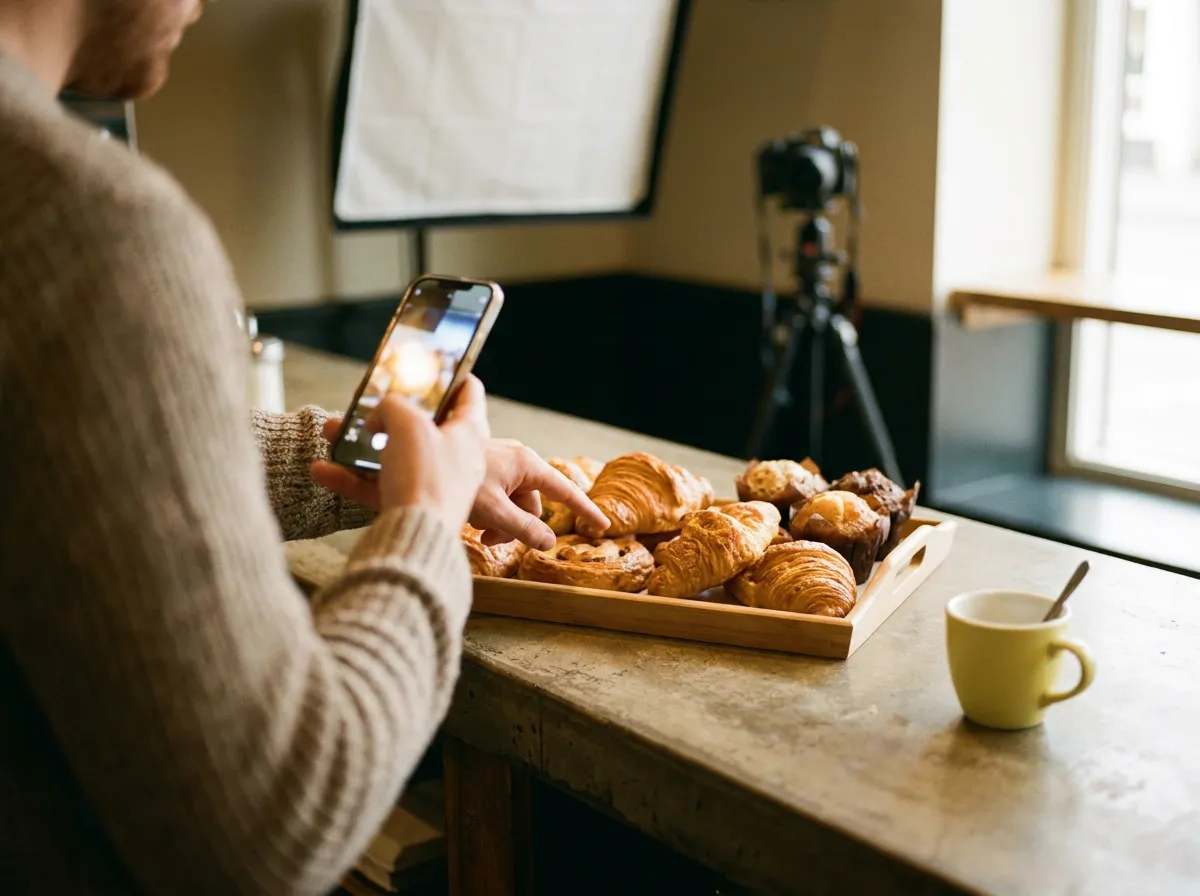
Movement helps too. A moving ad has a better chance in the first second than a still one, whichever style it’s in. See why moving ads stop the scroll.
Where AdForThat fits
AdForThat makes finished ads for a small business from its website, a sentence about what it sells, its logo or a product photo. The ads use your own name, words, photos and colours: moving ads, drawn ads, and break-outs, where something leaps out of the post and over the feed. Every ad comes in the sizes feeds, Stories and Reels use. It doesn’t make fake reviews or made-up customers.
You launch them to Instagram and Facebook from your own Meta ad account (TikTok, YouTube and LinkedIn are coming soon), and autopilot keeps the best ads running while fresh ones go in, so trying different styles side by side is easy. In our own experience, break-outs have been the best ads we’ve ever run for real businesses, with better engagement, more clicks and more conversions than anything else we’ve tried. See how it works, or make your first ads.
Questions people ask
What is a UGC-style ad?
A UGC-style ad is a paid ad made to look like a normal social post: shot on a phone, vertical, often one person talking to camera, with plain edits. It borrows the look of user-generated content, but it is still an ad, and when a paid creator makes it, it has to be labelled as one.
Do UGC ads perform better than professional ads?
Often, on attention and engagement. TikTok’s 2022 analysis found ads made for TikTok with a creator partner had 83% higher engagement rates. But polished ads tend to do better when people need to see the product clearly or remember the brand, and Kantar’s 2026 study found only 6% of creator posts both engaged people and built the brand. Test both with the same offer.
Do I have to label creator ads as ads?
Yes, if you pay a creator or give them free products. The FTC’s Endorsement Guides, updated in June 2023, require a clear and conspicuous disclosure, such as “#ad” at the start of a post and a disclosure inside a video, not only in the description. On Instagram and Facebook, creators use the Paid partnership label.
Can I use actors or AI-generated people as customer testimonials?
Not as if they were real customers. The FTC’s final rule on fake reviews, announced in August 2024, bans reviews and testimonials that pretend to be from someone who doesn’t exist, including AI-generated ones, or from people with no real experience of the business. Show real customers with their permission, or speak for your business yourself.
Should a premium or luxury business avoid lo-fi ads?
Not necessarily. Dash Social’s 2022 study of brands’ own Reels found phone-shot videos did better than produced ones in luxury too. But people paying more usually want to see detail and finish, so whatever camera you use, keep the light good, the shot steady and the product clear.
Is the “UGC is 9.8x more impactful” stat real?
It is repeated on many marketing sites and usually credited to a content platform’s survey, but we couldn’t find the original report or check what it measured, and some pages quote a different number. We would not rely on it. Your own test results are a better guide.
How do I test UGC-style ads against polished ads?
Run one of each with the same offer, link, audience and budget, ideally with your ad account’s A/B test option. Give them at least a week, then compare cost per booking, order or lead rather than likes. Keep the winner and test a fresh challenger against it.
Sources
- What we mean when we say ‘Don’t Make Ads’, TikTok for Business (2021)
- Brand collaborations with TikTok creators drive big results, TikTok for Business (Marketing Science) (2022)
- Unlock the power of Reels ads: boosting brand awareness and engagement, Meta for Developers (2024)
- Meta says partnership ads cut incremental purchase costs 45% in EMEA tests, PPC Land (2026)
- Understanding the ABCDs of effective creative on YouTube, Google (Think with Google) (2022)
- Validating Google’s ABCD framework with the power of artificial intelligence, Kantar (2021)
- Beyond martech: building trust with consumers and engaging where sentiment is high, Nielsen (2021)
- 2021 Nielsen Trust in Advertising, US highlights, Nielsen (2021)
- Social media brand community and consumer behavior: quantifying the relative impact of user- and marketer-generated content (Goh, Heng and Lin, Information Systems Research), INFORMS (2013)
- User generated content presenting brands on social media increases young adults’ purchase intention (Mayrhofer, Matthes, Einwiller and Naderer, International Journal of Advertising), University of Vienna (2020)
- “This post is sponsored” (Boerman, Willemsen and Van Der Aa, Journal of Interactive Marketing), Elsevier (2017)
- How do lo-fi videos compare to hi-fi video performance?, Dash Social (2022)
- What makes a good image? Airbnb demand analytics leveraging interpretable image features (Zhang, Lee, Singh and Srinivasan, Management Science), INFORMS (2022)
- Fewer than 1 in 15 pieces of creator content delivers both audience engagement and ROI, Kantar (2026)
- Cannes in a Can 2026: four signals shaping the future of brand growth, Kantar (2026)
- Federal Trade Commission announces updated advertising guides to combat deceptive reviews and endorsements, US Federal Trade Commission (2023)
- FTC’s Endorsement Guides: what people are asking, US Federal Trade Commission (2023)
- Federal Trade Commission announces final rule banning fake reviews and testimonials, US Federal Trade Commission (2024)
- Earn from brands, Meta for Creators
Make an ad that does all this
From your website, a product photo or a sentence. Try it free; pick a plan to download and launch.